- 9073052000
- 3rd Floor, DD 7, Sector 1, Salt Lake City, Next to ILS Hospital, Kolkata - 700064, WB

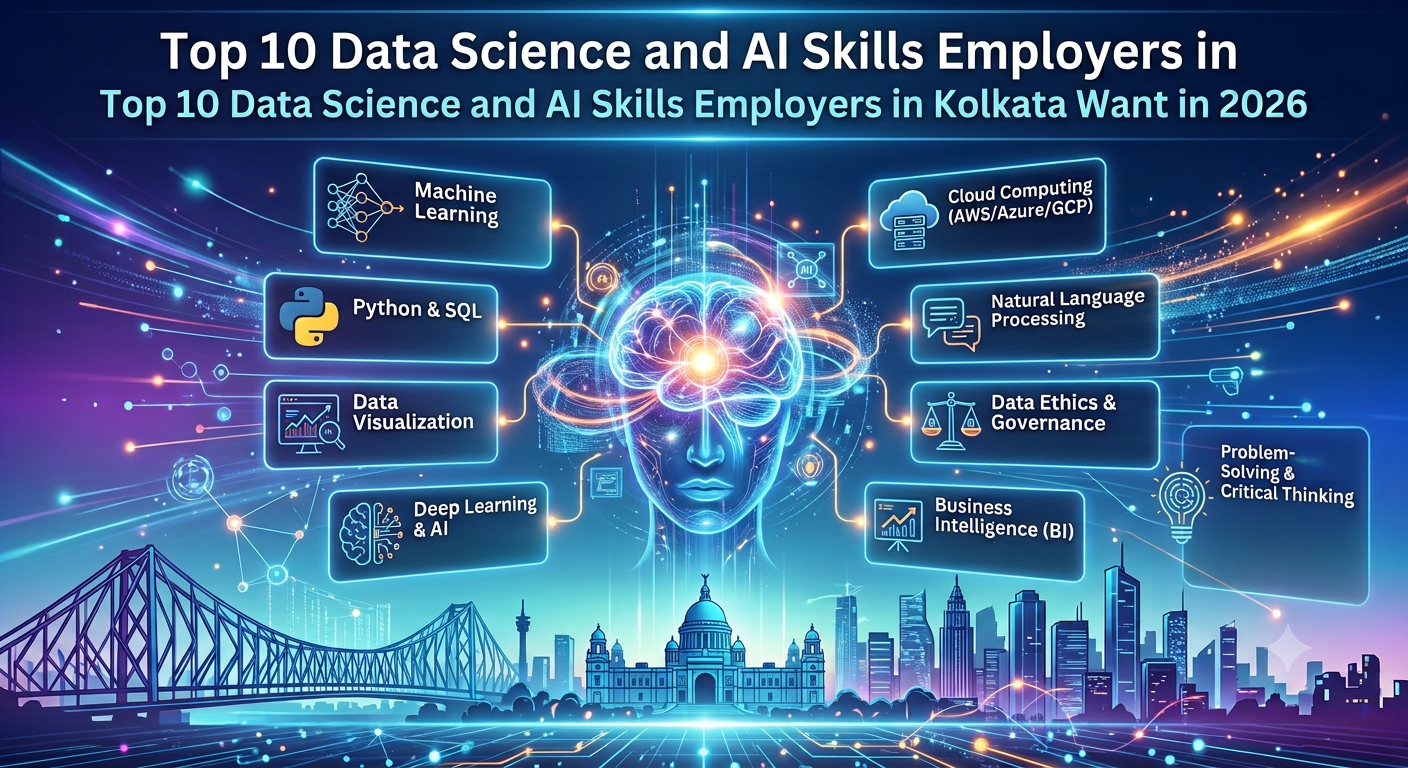
The top data science and AI skills employers want in 2026 are Python, SQL, data analysis, charts, statistics, machine learning, generative AI, automation, cloud basics and clear communication. Start with Python and SQL, then add one skill at a time. We are Shard Center for Innovation, Kolkata, and we explain each skill below.
Many learners ask us the same thing: “What should I learn first?” There are hundreds of tools, and new ones appear every month. This guide helps you pick. For each skill, we say what it is, why employers ask for it, and how you can show it.
The 10 skills at a glance:
We want to be clear about what this list is and what it is not.
Three facts help you plan.
AI skills are now common in job posts. Naukri’s report says AI skills appear in 15.4% of tech job descriptions in 2026. In 2020, it was 0.9%. That is nearly 17 times more.
Kolkata has a small share of AI jobs. CBRE looked at over 64,500 AI job listings on Naukri in December 2025. Kolkata had 2.1% of them. Bengaluru had 25.4%, Delhi-NCR 24.8% and Mumbai 19.2%. This does not mean there are no jobs here. It means fewer. So build skills that also work for remote jobs and jobs in other cities.
Most data scientist roles ask for experience. We did a quick check of public job listings for data scientist roles in Kolkata on 9 November 2026. Every listing we looked at asked for 2 years or more of experience. This is not a study. But it helps: if you are a fresher, aim first for roles like data analyst or business analyst. Then move into data science.
What it is: The most common language for data work. You use it to clean data, analyze it and build models.
Why employers ask for it: Almost every data and AI role uses it. It is also the base for machine learning.
How to show it: Put 3 to 5 projects on GitHub. Add clear notes on what each one does.
This is our view. It is the first skill we teach.
What it is: The language you use to ask questions of a database. For example: “Show me the sales in Kolkata, Delhi and Mumbai last month.”
Why employers ask for it: Company data lives in databases. LinkedIn’s 2026 list for India names writing database queries and making databases run better among the rising data skills.
How to show it: Write queries on a real sample database. Use joins and group-by in a project.
What it is: Real data is messy. Cleaning means fixing missing values, wrong entries and repeats. Analysis means finding what the data tells you. You may use Excel and Python tools like pandas.
Why employers ask for it: This is most of the daily work in a data role. A good model on bad data gives bad answers.
How to show it: Take a messy public dataset. Write down the problems you found and how you fixed them.
This is our view.
What it is: Turning numbers into charts with a clear message. Tools include Power BI, Tableau and Python charts.
Why employers ask for it: Managers do not read code. They read charts. LinkedIn lists data storytelling as a rising skill in India.
How to show it: Build one dashboard. Write three lines on what a manager should do after seeing it.
What it is: Averages, how far numbers vary, probability, testing ideas, and knowing if a result is real or just luck.
Why employers ask for it: It helps you avoid wrong conclusions. It is also the base for machine learning.
How to show it: Explain a test result in plain words in one of your projects. For example: “Sales rose 8%, and the chance this is luck is low.”
This is our view.
What it is: Teaching a computer to find patterns in data, so it can predict things. For example, which customers may stop buying.
Why employers ask for it: It is core to data scientist and AI roles. You do not need to know everything. You need to know the common methods and when to use each one.
How to show it: Build a model, test it on new data and explain where it fails. If you want a guided path, see our machine learning course in Kolkata.
What it is: Using tools like ChatGPT and Claude well. This includes writing clear prompts and checking the answers.
Why employers ask for it: LinkedIn names prompt engineering and workflow automation among the fastest-rising skills in India. Naukri’s report also shows AI skills in non-tech jobs. They went from 0.26% of job descriptions in 2020 to 1.59% in 2026.
How to show it: Show how you used an AI tool in a project. Say what you asked, what you fixed by hand and how you checked the result.
What it is: Making tasks run by themselves. An API lets one program talk to another. For example, you can pull data from a website into a report each morning.
Why employers ask for it: Saving time is a clear gain for a company. LinkedIn lists workflow automation and API integration among the rising AI skills in India.
How to show it: Build a small script that does a task on its own. Write a short note on the hours it saves.
What it is: Running data work on cloud services like AWS, Microsoft Azure or Google Cloud, not only on your laptop.
Why employers ask for it: Many companies store data and run models in the cloud. LinkedIn also lists cloud infrastructure among the rising skills in India.
How to show it: Put one small project on a free cloud account. Write down the steps.
Treat this as a second-step skill. Learn Python and SQL first.
What it is: Explaining your work in simple words. Knowing what the business needs. Listening before you build.
Why employers ask for it: Data work only matters if people act on it. LinkedIn notes that employers want people who can use data to take action.
How to show it: Present one project in 5 minutes to a friend who knows nothing about data. Practice until they understand it.
This is our view. We think it matters a lot.
| Skill | Learn it when | Easy way to show it |
|---|---|---|
| Python | Start here | 3 to 5 GitHub projects |
| SQL and databases | Start here | Queries on a sample database |
| Data cleaning and analysis | Month 2 | A clean-up report on messy data |
| Charts and data stories | Month 2 or 3 | One dashboard with a clear message |
| Statistics and math basics | Along with the first four | A plain-words result in a project |
| Machine learning basics | After the basics | A tested model with its limits |
| Generative AI and prompt writing | Anytime, from day one | A project where you checked AI output |
| Automation and APIs | After Python | A script that saves time |
| Cloud basics | After the basics | A small project on a free cloud account |
| Communication and business sense | All through | A 5-minute talk on one project |
Which skills to learn first, by where you are
Our data science course runs for 6 months, in the classroom. You can join after 10+2 in any stream. We start with programming basics, usually Python, and you learn by building hands-on projects. These can include a machine learning model or a data analysis case study. We prepare learners for roles such as Business Analyst, Data Scientist and Data Engineer.
| Skill | What our course covers |
|---|---|
| Python | Yes. We start with Python. |
| Statistics | Yes. |
| Machine learning | Yes. Our AI and ML course goes further, with regression, classification, clustering and neural networks. |
| Real projects | Yes. Hands-on and project-based. |
| SQL, charts, generative AI, automation, cloud and communication | Please ask us for the full syllabus to see which tools are included. |
You can see the course in full on our data science course in Kolkata page. If your goal is AI, see our AI course in Kolkata page. For roles you can aim for after the course, read about the career opportunities after a data science course.
What are the most important data science skills in 2026?
Python and SQL come first, because almost every data role uses them. Then add data cleaning, charts and statistics. After that, learn machine learning and how to use generative AI tools well. Communication matters at every step.
Which AI skills are growing fastest in India?
LinkedIn’s 2026 list for India names prompt engineering, workflow automation, LLMOps, AutoML and API integration. LLMOps means running and managing AI models. AutoML means building models with less manual work. Naukri’s report also shows AI skills in 15.4% of tech job descriptions, up from 0.9% in 2020.
Are there enough data science and AI jobs in Kolkata?
Kolkata has a smaller share than big hubs. CBRE’s study of Naukri listings found Kolkata had 2.1% of AI job openings in December 2025. Many learners look at remote jobs and jobs in other cities too. Build skills that work anywhere.
Can a fresher get a data scientist job in Kolkata?
It can be hard. In our quick check of public listings, every data scientist role asked for 2 years or more of experience. Many freshers start as data analysts or business analysts. Then they move up as they gain experience and projects.
Do I need to learn coding for AI jobs?
For most data and AI roles, yes. Python is the usual starting point. Some roles use AI tools with little code. But coding gives you more job choices.
How long does it take to learn these skills?
It depends on your time and practice. A structured course of a few months can cover the basics. Real skill comes from building projects and practicing every week. Our course runs for 6 months.
Do I need a degree in computer science?
Not always. We accept learners after 10+2 in any stream. Employers often check your projects and how clearly you explain them. A degree can help, but proof of your skills matters a lot.
Is a certificate enough to get hired?
A certificate helps, but it is rarely enough alone. Employers look at your projects, your portfolio and how you solve problems in an interview. Build real work you can show and explain.
Not sure where to start? Tell us your background and your goal. Send us a course enquiry on our Contact Us page, or call us on 9073052000. We will help you choose a starting point.