- 9073052000
- 3rd Floor, DD 7, Sector 1, Salt Lake City, Next to ILS Hospital, Kolkata - 700064, WB

Day by day, technology is evolving, and Artificial Intelligence (AI) is transforming the world into something more innovative, data-driven, and technical. Nowadays, AI is not only a part of the technology industry, but it has taken over in various industries such as healthcare, e-commerce, marketing and sales, manufacturing, education, and baking. This is not just helping those sectors but has also become a huge part of them. At one time, people used to think that AI only existed in fictional movies. Later, scientists and mathematicians turned this vision into reality, and AI has become the primary component of every sector in ways that people could not have predicted in the past.
When it comes to ‘what is this AI?’, AI is an advanced branch of computer science that allows machines to accomplish tasks as well as humans, even faster. It includes mathematics, statistics, machine learning, reasoning, decision-making, language understanding, and deep learning.
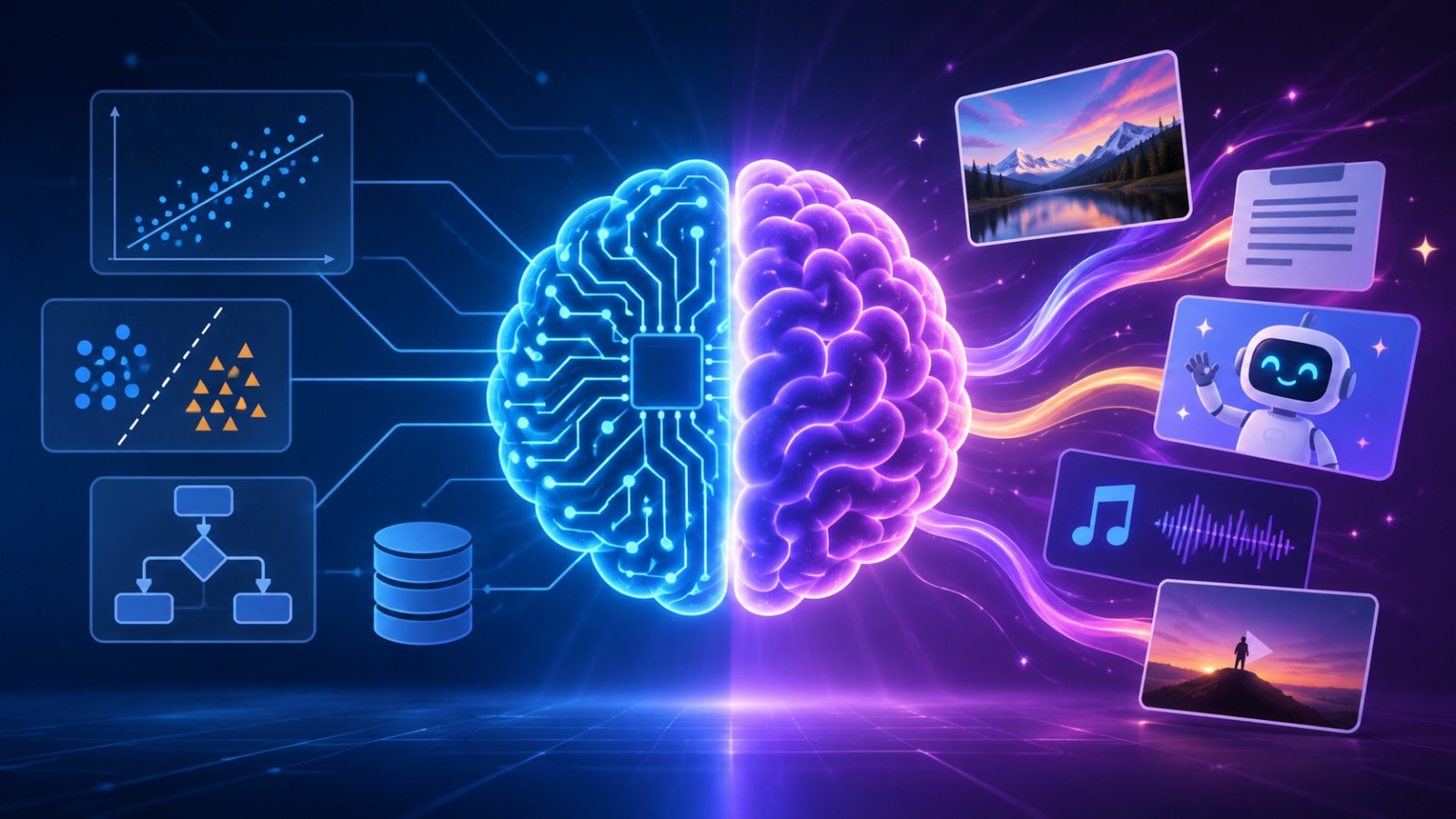
In addition to being an umbrella term, artificial intelligence (AI) may be broken down into two subfields: traditional AI and generative AI. In this blog, we will discuss ‘what is traditional AI’ and ‘what is generative AI’ and how these two work.
Traditional AI performs tasks by following strict rules, patterns from analyzed data, and instructions. Basically, traditional AI is designed to analyse information, make predictions, recognize patterns, and support decision-making. It analyzes data using mathematics, machine learning, and statistics and displays results depending on what it has been trained or programmed to recognize.
There are multiple roles of traditional AI, such as
Generative Artificial Intelligence, also known as Generative AI, refers to a segment of Artificial Intelligence that allows machines and computers to create new content as they understand the patterns and relations present within an enormous amount of data already available.
Artificial Intelligence is changing the way machines process information, solve problems, and carry out tasks. Traditional and Generative AI are two types of AI with different functionalities. The differences can be described below.
Both Traditional AI and Generative AI are changing the way technology operates and offering plenty of opportunities in many areas. While Traditional AI relies on the analysis of available data to identify some patterns, predict future occurrences, and help with the decision-making process, Generative AI goes a step further and creates new ideas, solutions, content, and concepts. Despite some differences in their working mechanisms and application areas, both technologies are vital in making businesses more efficient and productive. Knowing the difference between these two concepts enables people and companies to take advantage of both of them. As an AI professional or aspirant, you must grasp both of them and learn in depth about their applications. Shard Center for Innovation, Kolkata is one of the best AI institute in kolkata who provides comprehensive guide on every aspect on AI.
Shard Center for Innovation, Kolkata is one of the best AI and ML institutes in Kolkata.
Yes, Shard Kolkata offers 100% placement assistance after completing the course.
There are some facts that define why you should choose us, such as,
Shard Kolkata is associated with many renowned brands, including Capgemini, Cognizant, TCS, Infosys, Wipro, Amazon, Flipkart, Myntra, Meesho, Ajio, Tata Digital, Reliance Retail, and Nykaa.
AI & ml:
The AI/ML track goes beyond an overview. It covers core algorithms (regression, classification, clustering, neural networks), the mathematical intuition behind them, and hands-on model building — not just how to call a pre-built API.